Regulated work,
with receipts.
You brief the Architect; a run executes — spec, build, gate, retry, deliver — and every output ships with a cryptographically signed, publicly verifiable receipt and a chain of custody a court could read. Six governance profiles apply at run time, not after the fact. Your compliance team gets the trail. Your people stop driving the process.
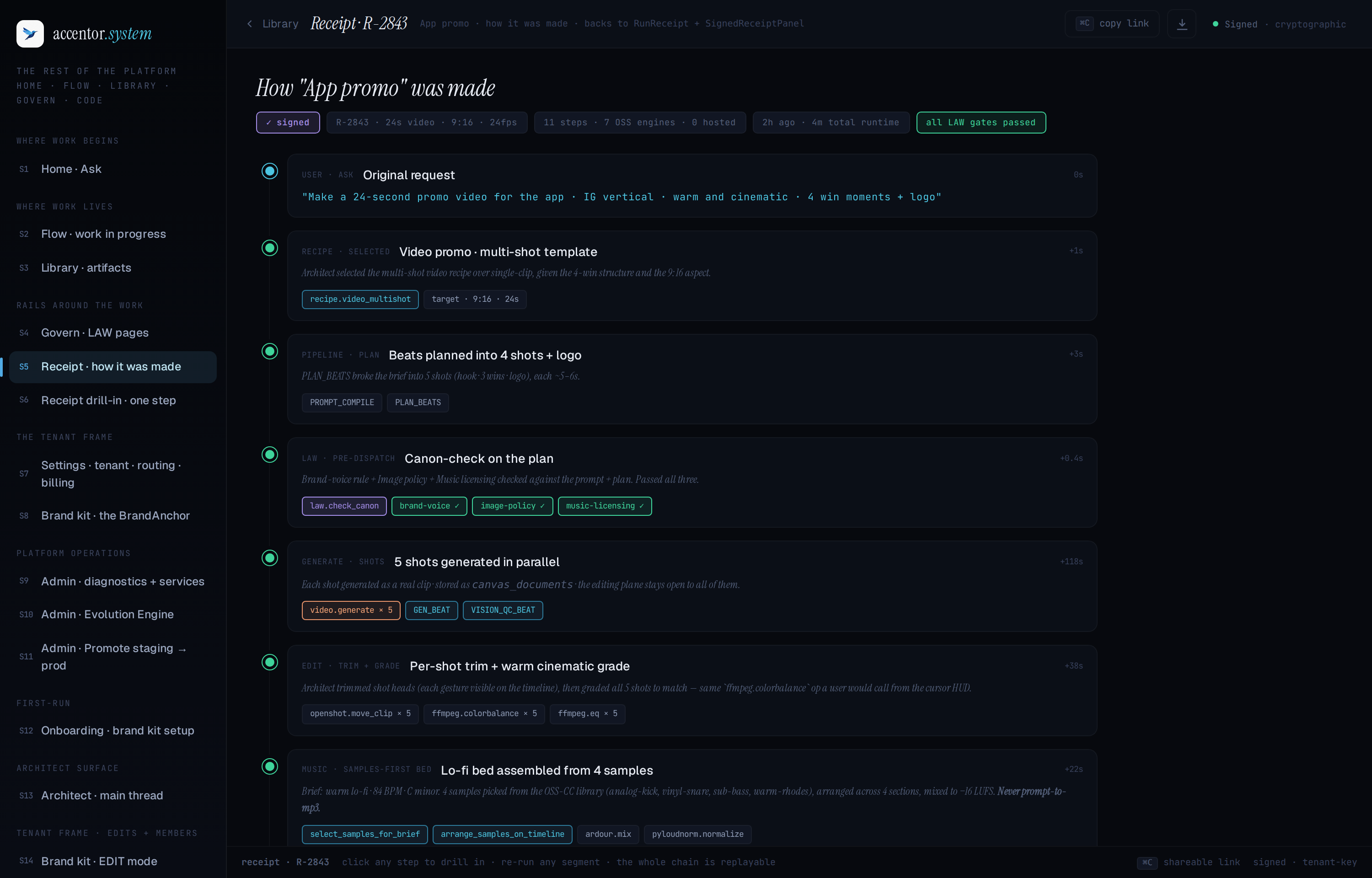
Signed delivery receipt — spec approved, gates passed, governance profile applied, model and cost recorded, HMAC signature verifiable at a public URL.
Six things your compliance team will actually ask for.
Work that finishes — because it has to clear a gate.
Accentor is not a thin API wrapper. Under the Architect sits the Engine Room — more than 5,200 real software operations that run the same way every time — and a real spec → gate → receipt loop. A run does not deliver until it passes.
Every gate is a measurable assertion — PHI absent, citations present, residency honored, cost within budget, rollback captured. When a gate fails, the run retries; it does not hand a person an unchecked draft. The gate is what makes the receipt mean something.
Six profiles, ready on day one.
Each profile is a named set of rules the Architect enforces as gates during the run. Applied at production time, attached to the receipt, visible on every output.
Addressable, append-only, exportable.
Every step writes an event. Every event is addressable by URL, shows actor, subject, rule, outcome, and evidence, and the log is append-only. There is no separate compliance review step — the chain of custody is the compliance review. Export the whole trail as a signed PDF.
The short list.
- Data residency: US, EU, or APAC — chosen at tenant creation. Model-provider selection filters accordingly.
- Encryption: TLS in transit, AES-256 at rest, HMAC-signed receipts and audit entries.
- Access: SSO (SAML 2.0) and SCIM 2.0 provisioning on Enterprise. Role-based permissions at workspace, project, and output level.
- Retention: configurable from 30 days to indefinite. The audit log is retained indefinitely by default.
- Private routing: teams with existing OpenRouter, FAL, Together, Model Studio, or Cerebras contracts can route through their own committed capacity — a procurement option, not the product.
- Infrastructure: hosted on SOC 2 Type II infrastructure (Railway + Supabase, audited quarterly). Accentor’s own Type II audit is in progress.
Bring your provider contracts. Keep the loop.
A procurement option — not the product.
If your team already holds committed capacity with OpenRouter, FAL, Together, Model Studio, or Cerebras, Enterprise can route rendering through your own agreements. The work still goes through the same loop: the Architect specs it, gates it, retries failures, signs the receipt, and opens the editable Canvas.
You are buying finished, gated, receipted productions — the orchestration, the gates, the chain of custody, the editable session. Private routing just decides which committed capacity your jobs run on. It is a way to satisfy procurement, not a different product.
Through procurement in 2–4 weeks.
- SOC 2 Type II readiness letter available; full Type II audit in progress — ask us for current status
- DPA pre-signed and editable
- HIPAA-adjacent profile with BAA discussion on request — talk to counsel about covered-entity fit
- Security questionnaire responses on file (SIG Lite, CAIQ, VSA)
- Custom SLA available at Enterprise tier
- Dedicated channel with our founding team
Talk to us
We're a small, senior team. No BDRs. No “book a demo” funnels. You will speak to an engineer on the first call.